

dear chronic overshooters: aftershoot has entered the chat 😭
(an honest aftershoot review from a photographer who rather takeS 40 versions of the same moment than simply choose one 🤪)
photographer besties, i fear i have found something extremely useful
i am a chronic overshooter. because i prefer to photograph through moments: i’m watching the expression change, the shoulders relax, the movement settle, the laugh happen halfway through the pose. sometimes the first frame is technically perfect and frame seven is the one where the person actually feels like themselves.
which is lovely and I enjoy my process… all the way up until I have to sit down and cull 2k photos from a portrait session lol. 🥲
culling has always been one of those weird friction points in my photography workflow. i love photographing a lot. i love editing and making creative decisions. i do not particularly love staring at 14 nearly identical photographs trying to decide which head tilt position speaks to me spiritually because the answer for me is always “all of them” lol.
so when i started experimenting with Aftershoot’s AI culling tool for photographers, i wasn’t looking for something to take control of my photography. eeek, in fact I was so scared of letting go of that control. instead i wanted an assistant for the parts of the workflow that were eating time and mental energy without really needing all of my creative brain.
and that is basically how Aftershoot snuck into my workflow. i didn’t thiiiink i’d like it but here we are. 🤷♀️
what i was actually looking for in an ai photography tool
i started testing Aftershoot for the first time starting back in May 2025 because i wanted help with three things: culling, editing and retouching. more specifically, i wanted something that could help me move through large wedding galleries faster without making my photographs feel like they had been processed by somebody else.
my editing philosophy has always leaned toward preserving skin texture, expression, atmosphere and the little imperfections that make someone look like an actual person instead of an AI manifestation, especially with boudoir! i want someone to recognize themselves in their photographs!!!
that’s one of the things that originally made Aftershoot super interesting to me. its approach felt much closer to a frequency seperation skin smoothing look vs. a weird Denoise or AI transformation look for the retouching and that appealed to me a lot as someone who was spending way too much time in Photoshop (bc I personally always felt like Portraiture skin smoothing had a weird look to it).
okay but what does aftershoot actually do?
Aftershoot is an ai assisted photography workflow tool that can help with culling, editing and retouching. instead of sitting there manually sorting through every single photograph from the beginning, you can let the software make an initial pass and then step back in with your own eyeballs and opinions.
i’m still the photographer. i still decide which weird little expression matters. i still know that image 472 technically isn’t the cleanest frame but it has the laugh i was waiting for. i still make the final creative decisions.
aftershoot just helps me reach those decisions without spending quite so much of my life clicking between nearly identical RAW files.
aftershoot vs. evoto: what i noticed
i tested multiple ai photography tools because i wanted to see where each one fit into an actual working photographer’s workflow rather than assuming every program was basically doing the same thing.
they weren’t.
and because apparently i cannot simply have an opinion without eventually making a chart about it, i made a comparison table. 😂
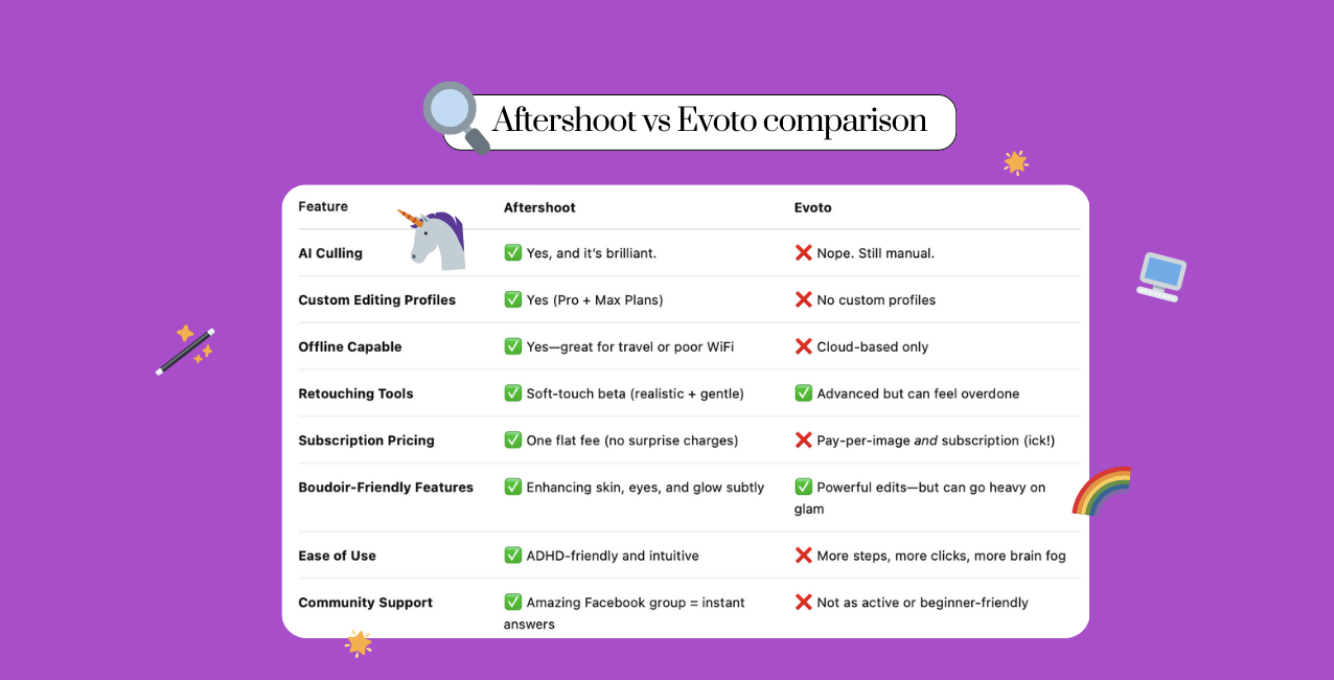
the biggest difference for my workflow was that aftershoot felt more aligned with the kind of assistance i actually wanted. i wasn’t searching for the most dramatic transformation possible. i wanted something that could quietly remove some repetitive decisions while leaving me in control of the photograph.
the retouching matters to me for a different reason
this is probably where i become especially picky because i photograph boudoir.
there is a difference between retouching a photograph and quietly communicating to someone that their actual human body needed to be corrected.
i care a lot about that difference.
my preference has always been a soft touch. soften something distracting if i need to. brighten the eyes a little. gently address temporary things. but i don’t want to casually warp somebody’s body into a different body because software gave me the option.
aftershoot’s retouching caught my attention because it felt closer to enhancement than reconstruction. i could preserve skin texture and the recognizable person underneath the edit instead of pushing everything toward that slightly uncanny, hyper perfected look.
and honestly, that matters more to me than whether a program can technically do the most.
i want the technology supporting the photograph, not deciding what a human being should look like.
that philosophy runs through basically everything i do with ai now. the question isn’t only, can this tool do this?
it’s also, do i actually want it to?
that little distinction has saved me from a lot of shiny software syndrome lol.
and then there’s the culling
if you are a wedding photographer, event photographer, portrait photographer or fellow chronic overshooter, this is probably the part you care about.
ai culling gives me a starting point.
that’s it.
and weirdly, that’s enough to make an enormous difference.
instead of opening a gallery and facing one giant undifferentiated wall of thousands of photographs, i’m entering the decision making process with some of the repetitive sorting already started.
i can review. override. disagree. rescue a frame the ai didn’t understand. toss something it liked that i absolutely do not. 😂
because ai does not understand the emotional context of a photograph the way i do.
it doesn’t know that technically imperfect frame is the exact second someone stopped being self conscious.
it doesn’t know why i photographed through the laugh instead of stopping at the pose.
it doesn’t know the relationship between the people in front of me.
that’s my job.
the software is just helping with the pile.
and that is probably the cleanest explanation i can give for how i like using ai in photography.
honestly, the community has helped too
one thing i didn’t expect to care about as much as i do is the aftershoot photographer community.
new software always has that slightly annoying period where you’re staring at the screen going, “okay but where is the button that does the thing i swear everyone else knows how to do.” 😭 having other working photographers sharing settings, workflows, questions and weird little discoveries has made integrating the software much easier.
i’ve also appreciated seeing photographers use the same tool completely differently. there isn’t one sacred aftershoot workflow everybody has to copy. wedding photographers have different needs than boudoir photographers. high volume photographers have different needs than someone delivering 40 image portrait galleries.
i like tools that can sit underneath a creative process without demanding that everybody create the same way.
[keep your aftershoot community facebook group link here]
okay, but is aftershoot perfect?
well nope, i’m still figuring it out and learning new things about the program every day tbh. i’m not trying to present myself as an Aftershoot guru or expert lmao just a girlie with a camera who… idk… really likes the program she’s purchased??? 🤷♀️
Aftershoot was still actively evolving while I first found it in early 2025! features have since changed. updates came out. things have improved at an astonishing rate imho.
that’s a part of why i’ve enjoyed using it. this “AI company” is this awesome little techy project between a couple of dudes who got together to try and solve a real problem for photographers who were staying up too late culling, editing, and retouching. and i’ve watched them grow and improve and hear out real customer feedback and never do anything slimy like you-know-who’s “AI headshot generator” lmao.
anyway I DON’T need software to perfectly imitate me. i need it to make the peak boring parts easier and faster without getting in the way of the creative parts i care about.
it only took me 2-3 months of first using Aftershoot to get a real feel for the program and how to implement it more usefully into my actual workflow. the team has also been responsive to photographer feedback, which makes me much more comfortable investing in a tool that is still evolving while not being out of touch.
Aftershoot is basically my photography workflow chemical x right now. 🧪✨ still developing, occasionally surprising me, but extremely useful in exactly the places my brain tends to run out of patience lol.
so... is aftershoot worth it?
for me? yes. especially because the thing it gives me back isn’t just editing time. it gives me back tons of decision making energy. basically: I get to end my days with soooo many more spoons available (if you’re into the Spoon Theory).
one tiny decision (like culling) might not be mentally exhausting, but five hundred of them quietly stacked on top of each other absolutely can be. Aftershoot doesn’t make those decisions disappear necessarily. it streamlines the fuck out of the process for me though. it just helps me spend a little less energy on the decisions that aren’t. that’s the difference.
🦄 wanna try aftershoot?
if you’re curious, my suggestion is actually not to immediately rebuild your entire photography workflow around it because some girl on the internet wrote an enthusiastic blog post.
but definitely go try the free trail.
let it cull a few different galleries you’ve already culled yourself and compare the results. try the editing tools on photographs you already know well. pay attention to what you override and what genuinely saves you time.
the goal, at least for me, was never about removing myself from creative interpretation, manual editing, or final decisions.
it’s removing enough of the tiny steps, that unnecessary friction, so that i still have some mental capacity left in my weeks for the creative parts of my business that actually need me.
affiliate disclosure: this is my referral link, which means i may receive a benefit if you sign up through it. i’m recommending it because i actually use it in my own photography workflow. as always, vet the thing yourself and decide whether it works for your own weird photographer brain.
